The 70–75% fulvic acid number — how to read a Shilajit lab report
Every jar of good Shilajit should come with a lab report. Almost none do, and almost nobody knows how to read one when they do.
Let us fix both.
What "fulvic acid content" actually measures
When a lab tests Shilajit for fulvic acid, it is measuring how much of the jar is the active molecule — the one Ayurveda quietly built its Shilajit reputation on. The higher that number, the more of what you are actually swallowing is doing something.
The catch is that different labs report the number in different ways. Some report fulvic acid as a percentage of the entire resin — soil, minerals and all. Others report it as a percentage of the humic fraction — the extractable, biologically active part. Both methods are legitimate. But the same jar of resin will read very differently depending on which one was used.
For context: a raw, unpurified block of Shilajit often tests between 15 and 20% fulvic acid when measured against the whole resin. A well-purified resin tests between 70 and 75% when measured against the active fraction. That is the gap between something that came out of a rock and something you would want to put in your mouth.
Why 70 to 75 is the number worth chasing
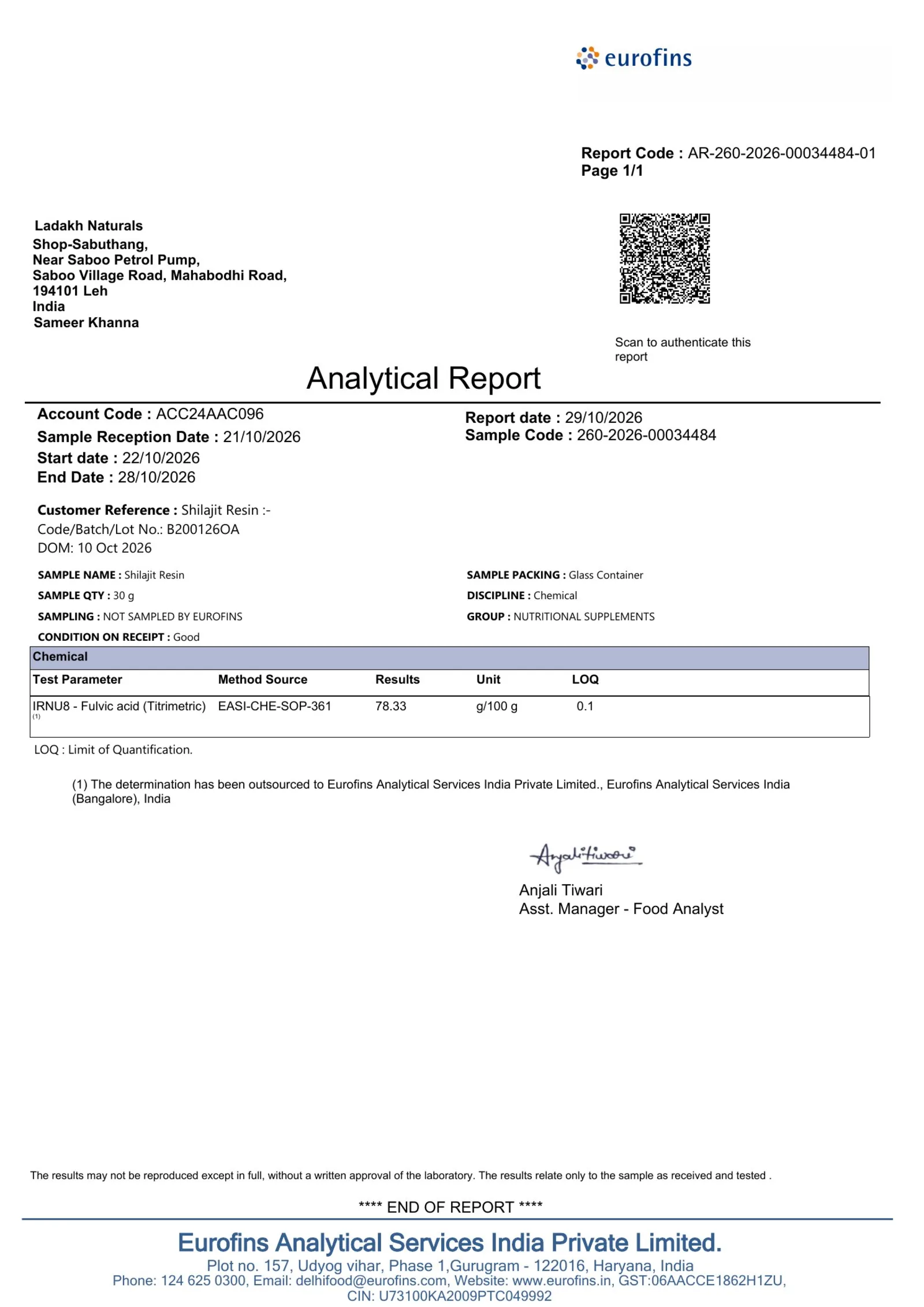
We test every batch of Ladakh Naturals Shilajit for fulvic acid content on the active-fraction basis, and we do not release a batch below 70%. Below that, the resin is either under-purified or diluted with less active humic material. Push much above 75, and you start to worry that a lab was pressed for a headline-friendly number.
Seventy to seventy-five is the honest, purifiable sweet spot. High enough to be worth taking. Grounded enough to be believable.
Here is the actual line from our most recent batch — October 2026, lot B200126OA, tested at Eurofins:

That is the number our label will carry for this batch. The report is one page, signed, with a scan-to-authenticate QR code against Eurofins's own servers. You can ask for the PDF of the batch you receive and we will send it.
The other numbers on a real lab report
Fulvic acid content is not the only line that matters. A genuine Certificate of Analysis will also show:
**Heavy metals.** Lead, arsenic, mercury and cadmium. Shilajit forms in rock; rock naturally contains metals; purification is what removes them. Look for actual numbers well below the regulatory ceiling — not a vague "meets standards" line.
**Microbial safety.** Total plate count, yeast and mould, coliforms, E. coli, salmonella. Resin is a food; edible things must be safe.
**Batch and date.** Every jar should trace back to a specific harvest and a specific test date. If a lab report is undated or unbatched, it is a marketing sheet, not a Certificate of Analysis.
How to sanity-check any Shilajit brand
Three quick questions before you buy:
- •What method was the fulvic acid percentage measured against — whole resin, or active fraction? If the answer is vague, that is your answer.
- •Which lab did the testing? A real answer is a name — Eurofins, SGS, Intertek, or a certified Indian equivalent — not a logo.
- •What is the batch number of my jar, and can I see its signed COA? If the seller cannot produce one for the specific jar you are about to eat from, you are buying story, not resin.
Why we chose to put a number on the packaging
Colour, smell, and dissolution tricks are easy to fake. A signed lab report from a certified laboratory is not. That is why, of all the things we could have printed on our packaging, we chose the number: **fulvic acid > 70%**. Not because it sounds good, but because it is the one claim you can independently verify — and the one that decides whether a jar of Shilajit is actually worth eating.